

A typical time-to-hire runs roughly 30 to 44 days, though tech and engineering roles push well past that while retail and hospitality often close much faster. Before you compare your own numbers against any benchmark, check that you’re measuring time-to-hire and not time-to-fill. They start and end at different points, and mixing them up makes every comparison meaningless.
TL;DR:
- Time-to-hire typically ranges from 30 to 55 days across industries, with engineering roles often taking longer due to multi-stage evaluations.
- Differentiating between time-to-hire and time-to-fill is crucial, as delays in requisition opening can distort hiring speed metrics.
- The biggest process delays usually occur in scheduling interviews and decision-making, which can be reduced through automation and clear policies.
- Speeding up hiring without harming candidate experience requires careful management of scheduling, feedback deadlines, and candidate communication.
- External recruitment support is advisable when internal processes consistently fall above the 75th percentile, especially for roles with slow or complex hiring pipelines.
Table of Contents
- What’s the difference between time to hire and time to fill?
- What are typical time to hire benchmarks by industry?
- How do you calculate time to hire and time to fill correctly?
- Where does the time actually go in your hiring funnel?
- How can you reduce time to hire without cutting corners?
- What should you track to keep improvements sustainable?
- What actually moves the needle, and where speed backfires
- When is it faster to bring in a recruitment partner?
- Sources
What’s the difference between time to hire and time to fill?
Time-to-hire measures the days between a candidate’s first engagement, whether that’s an application or a sourced approach, and their acceptance of an offer. Time-to-fill measures something broader: the days between a requisition opening and the role being filled, which some organisations count to offer acceptance and others count to the new hire’s start date.
The distinction matters because time-to-hire and time-to-fill measure different things, and reporting one as the other skews every benchmark comparison you make afterwards.
Two examples show why the gap matters:
- Example A: A role opens on 1 March. A strong candidate applies on 10 March and accepts an offer on 2 April. Time-to-fill runs from 1 March (32 days). Time-to-hire runs from 10 March (23 days).
- Example B: A hard-to-fill technical role opens on 1 March, sits unadvertised for three weeks while the job description gets rewritten, then a candidate is sourced on 22 March and accepts on 18 April. Time-to-fill is 48 days. Time-to-hire is just 27 days.
Notice how the second example makes recruiting look faster than it actually was, because the requisition delay never touches time-to-hire. That’s exactly why HR managers need both figures, not one.
What are typical time to hire benchmarks by industry?
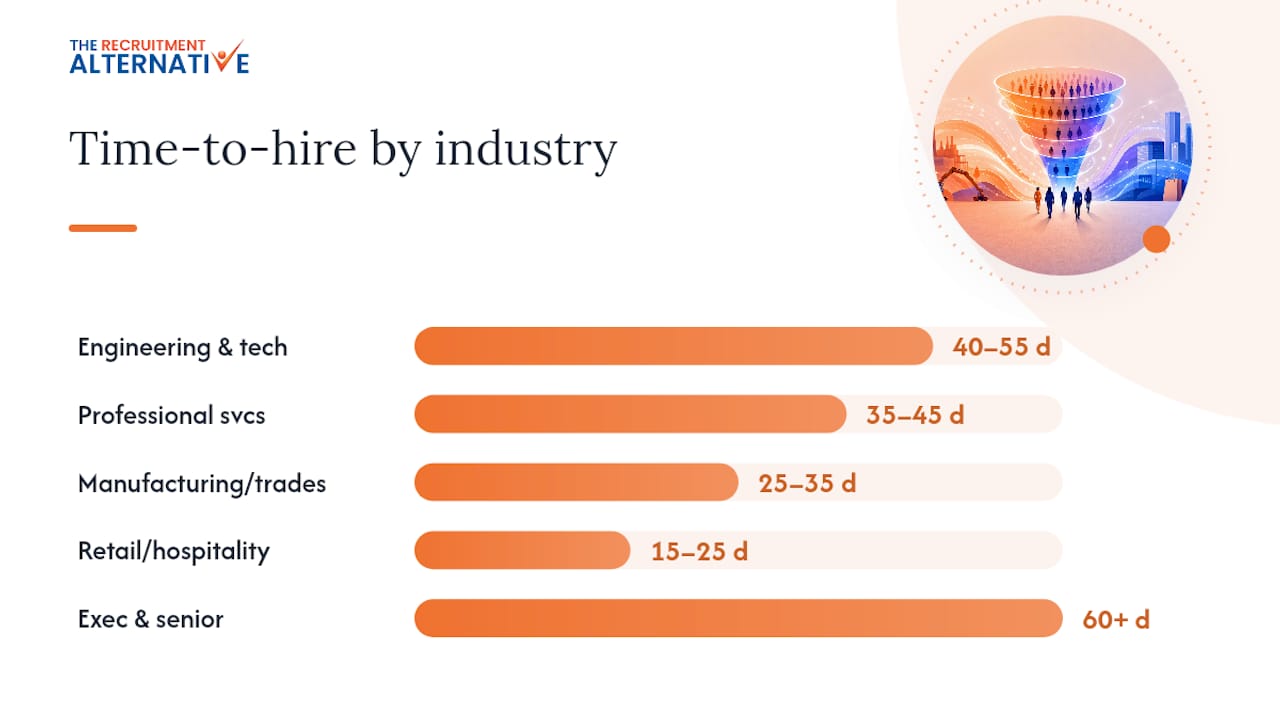
Averages hide more than they reveal here. A company-wide figure blending graduate hires with senior engineers tells you almost nothing useful, which is why role segmentation matters more than a single headline number. Industry benchmarking bodies including SHRM, Josh Bersin, and Indeed recorded a record median near 44 days in 2024–25, with wide regional and functional spread underneath that headline.
Representative medians by role family, drawn from current recruiting benchmark reports, look roughly like this:
- Engineering and technology: Often 40 to 55 days median, driven by technical assessments and multi-stage panel interviews.
- Professional services (finance, legal, consulting): Typically 35 to 45 days, reflecting layered approval and reference checks.
- Manufacturing and trades: Usually 25 to 35 days, with faster cycles for high-demand trades roles.
- Retail and hospitality: Often 15 to 25 days, since volume roles usually run a single interview stage.
- Executive and senior leadership: Frequently 60 days or more, given search breadth, stakeholder alignment, and negotiation time.
When you set your own targets, use percentiles rather than one average figure. The 25th percentile represents a stretch target, the 50th percentile (median) represents typical performance, and the 75th percentile represents a reasonable baseline to improve from. Segmenting this way, rather than blending role types into one company-wide average, stops you comparing a graduate hire’s speed against a specialist engineer’s and drawing the wrong conclusion about either.
How do you calculate time to hire and time to fill correctly?
Getting the formula right matters less than getting the inputs consistent. Here’s how to run both calculations without the common traps:
- Single-role time-to-hire: Offer acceptance date minus first candidate engagement date, in calendar days.
- Average time-to-hire: Sum of individual time-to-hire figures across a group of hires, divided by the number of hires in that group.
- Single-role time-to-fill: Fill date (offer acceptance or start date, pick one and keep it constant) minus requisition open date.
- Decide calendar or business days upfront and apply it consistently. Calendar days are simpler and match how candidates experience the wait; business days flatter your numbers around weekends and public holidays.
- Treat sourced candidates, internal moves, re-hires, and backfills separately. A boomerang re-hire or an internal transfer often skips stages that external candidates go through, so blending them into the same average distorts the figure.
- Before comparing to any industry percentile, audit your data for missing start dates, duplicate requisitions, and roles left open past their fill date without being closed in the system.
Skipping that last check is the single most common reason a company’s benchmark comparison turns out wrong.
Where does the time actually go in your hiring funnel?
Break the funnel into its stages and the delay rarely sits where people expect. Application review typically takes a few days. Scheduling lead time, the gap between requesting an interview and it actually happening, often runs several days. The interview loop itself (all rounds combined) frequently spans about one to two weeks. Decision lag after the final interview adds several additional days, and offer turnaround, from decision to a signed acceptance, typically adds a few more.
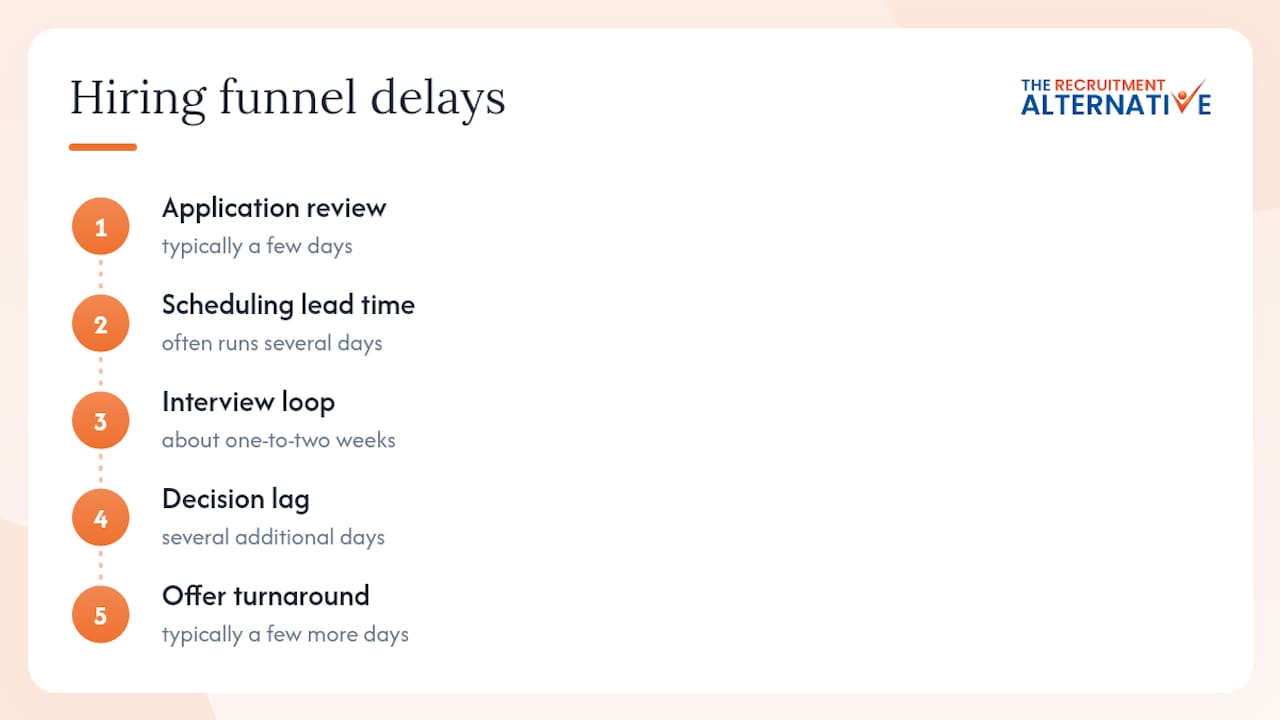
Scheduling lead time and decision lag are usually the two biggest reducible chunks, because they’re driven by process friction rather than genuine work. Large-sample analyses of recruiting operations show time-to-hire is rarely one big bottleneck; it’s dozens of small delays stacking up across application review, scheduling, interviews, and decisioning.
That distinction matters for where you spend your effort. Scheduling responds well to tooling, since automated scheduling ran notably faster than manual coordination in some datasets. Decision lag responds better to policy, specifically a named decision owner and a deadline, than to any software purchase.
How can you reduce time to hire without cutting corners?
Start with the changes that touch the biggest reducible stages first, then work down the list:
- Automate interview scheduling. Removing manual back-and-forth email chains is consistently the fastest win recruiting teams report, and it compounds across every open role.
- Set an SLA for interview feedback, typically 24 to 48 hours after each interview, so decision lag doesn’t quietly stretch to a week.
- Build template offer packs in advance for common role bands, so offer turnaround doesn’t wait on a manager drafting terms from scratch.
- Invest in sourcing pipelines and referral programs to shorten time to first contact, particularly for roles where inbound applications run thin.
- Redesign serial interview loops as parallel where possible. Running two panel rounds back to back on the same day, instead of a week apart, can cut the entire loop’s duration substantially.
- Use AI for screening and scheduling carefully. Case-study evidence shows AI screening and automated scheduling can deliver significant time-to-hire reductions on volume roles, with smaller gains for senior technical roles that need multi-stage assessment regardless of how fast the front end moves. Tools like the ones covered in this overview of small-business AI adoption are worth testing on high-volume roles first.
Pro Tip: Before rolling out any speed initiative company-wide, run it as a two-week A/B test on one role family, comparing time-to-hire and offer acceptance rate against a control group that keeps the old process. If acceptance rate drops even as speed improves, you’ve found a candidate-experience problem before it scales.
What should you track to keep improvements sustainable?
A one-off fix rarely holds without a dashboard tracking it. Five fields matter most: time-to-hire, time-to-first-interview, interview cycle time, offer-to-accept duration, and time-to-hire broken down by source channel.
- Set targets at the 25th percentile for roles where you’re actively trying to outpace competitors for talent.
- Use the 50th percentile (median) as your realistic default target for most role families.
- Treat the 75th percentile as the ceiling that signals a process problem worth investigating immediately.
- Run improvement as a 30 to 60 day experiment: pick one bottleneck stage, change one variable, and measure the shift in that stage’s median before rolling the change out further.
SHRM’s benchmarking guidance supports segmenting by role and using percentile bands rather than a single blended average when you’re setting these targets and reporting them to leadership.
What actually moves the needle, and where speed backfires
Two lessons hold up across most of the benchmarking data worth trusting. First, time-to-hire rarely fails because of one dramatic bottleneck. It fails because five small stages each run a couple of days too long, and nobody owns the sum. Second, the fastest fix is almost never the interview itself. It’s the scheduling gap around it.
Some recruitment agencies’ own placements across Australia’s current hiring market back this up: clients who tighten scheduling and decision ownership see faster hires without touching interview quality at all.
The caveat worth taking seriously: speed that outruns candidate experience backfires. Overly aggressive scheduling that offers slots a candidate can’t realistically make will lower acceptance rates even as your time-to-hire figure improves. A fast hire who declines the offer isn’t a fast hire. It’s a wasted month.
— Josh Townsend
When is it faster to bring in a recruitment partner?
Optimising your own process closes some of the gap, but some delays are structural. If your team is sourcing from a thin internal network, screening candidates without dedicated recruiting capacity, or juggling scheduling across a hiring manager’s already-full calendar, no amount of process tweaking closes that gap fast enough.
A flat-fee alternative to commission-based agencies offers dedicated sourcing and screening capacity without paying a percentage of the new hire’s salary. Because the fee is fixed rather than tied to salary negotiations, there’s no incentive dragging out the process to inflate a percentage cut, and pipelines get built specifically for the role rather than pulled from a generic candidate pool.
If your in-house numbers are sitting well above the 75th percentile for your role family, that’s usually the signal to bring in support rather than keep tweaking internally. The Recruitment Alternative covers sales, finance, engineering, healthcare, technology, trades, and executive roles across Australia and New Zealand, with a simple flat-fee structure and replacement cover if a placement doesn’t work out in the first few months. Check your current placement fees and turnaround to see whether outsourcing the bottleneck stages makes sense for your next hire.
Sources
- Recruiting operations benchmarks | Ashby talent trends
- Recruiting Benchmarks 2025-2026 report (SmartRecruiters)
- SHRM recruiting benchmarking (data brief)


