

A structured interview uses pre-written, job related questions asked in the same order and scored against a rubric, so every candidate answers the same prompts under the same conditions. That consistency makes hiring decisions fairer and easier to defend. The next step is designing questions that map directly to the outcomes and competencies your role actually needs.
TL;DR:
- Structured interviews significantly improve the accuracy of predicting job performance, with a typical predictive validity of around 0.50 compared to 0.30 to 0.38 for unstructured formats.
- Designing effective questions requires defining clear role outcomes and competencies first, then translating them into specific, behavior-based prompts with pre-scripted probes.
- Consistent scoring with behavioral rating scales and independent note-taking helps reduce biases such as halo effect and similarity bias during evaluation.
- Limiting each interview to 6 to 8 core questions and calibrating scores across panel members ensures reliable and fair candidate assessments.
- Using structured formats at crucial hiring stages creates an auditable record, making decision justification easier and more defendable if challenged.
Table of Contents
- What are structured interview questions and how do the formats differ?
- Why use structured interviews over unstructured ones?
- How do you design structured interview questions from the job itself?
- How do you score and calibrate structured interview answers?
- A ready-to-use structured interview question bank
- How do you run a structured interview without losing consistency?
- Common pitfalls that undermine structured interviews
- A 5-step structured interview checklist
- What running structured interviews at scale actually teaches you
- Want structured hiring without building the rubric yourself?
- Sources
What are structured interview questions and how do the formats differ?
Unstructured interviews drift. One candidate gets asked about weaknesses, the next gets a friendly chat about their weekend, and the panel ends up comparing impressions rather than evidence. Structured interviews close that gap by fixing the questions, the order, and the scoring method in advance, so candidates can be compared objectively rather than by gut feel.
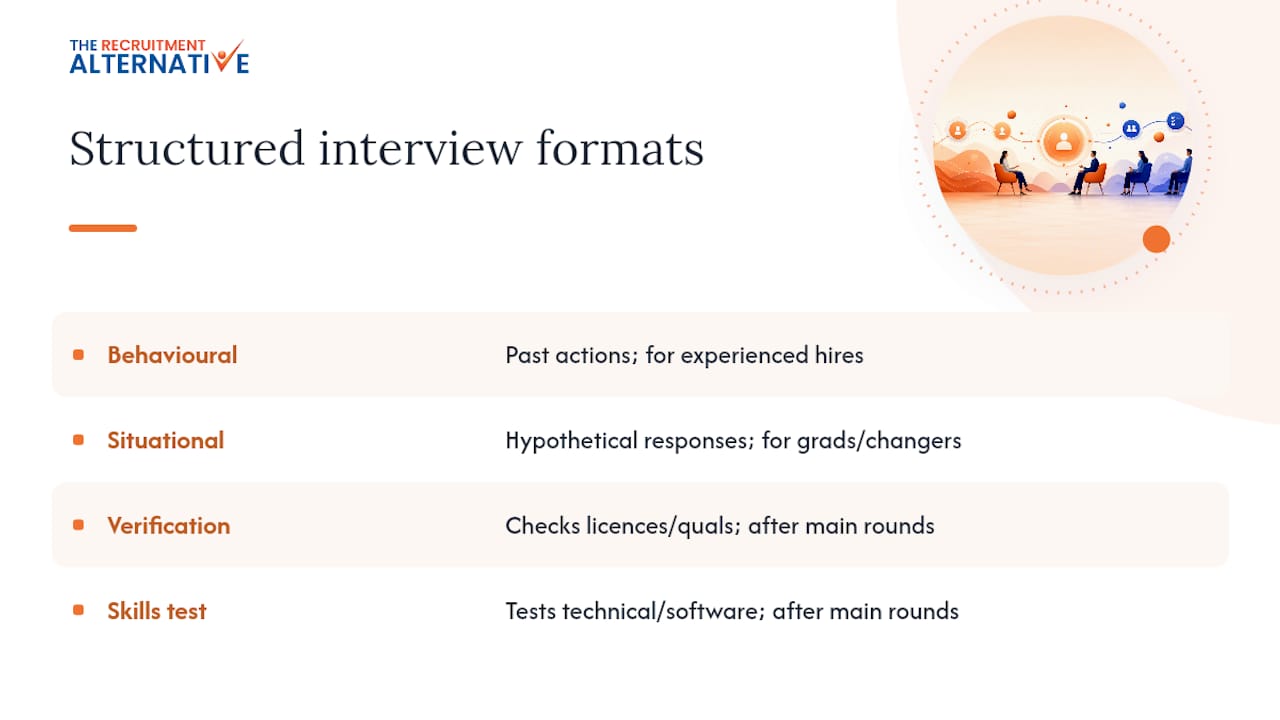
The two workhorse formats are behavioural and situational. Behavioural questions ask about past actions, framed as “tell me about a time…”, while situational questions ask how a candidate would handle a hypothetical scenario they haven’t necessarily faced yet. Behavioural prompts work best for roles where you have plenty of past candidates with relevant experience. Situational prompts fill the gap for graduates or career changers with no direct track record.
Verification questions and skills tests sit alongside these two, confirming licences, technical knowledge, or software proficiency the role legally or practically requires. Slot them in after the behavioural and situational rounds, once you already have a sense of whether the candidate is worth taking further.
Why use structured interviews over unstructured ones?
The predictive validity gap is the strongest argument for structure. Meta-analyses comparing interview formats put structured interviews at a typical predictive validity of around r ≈ 0.50, against roughly 0.30 to 0.38 for unstructured formats. In plain terms, structured formats are considerably better at predicting who will actually perform well on the job.
The evidence: Structured interviews outperform unstructured conversations at predicting job performance, roughly r ≈ 0.50 versus r ≈ 0.30 to 0.38 for free-flowing chats, according to comparative research cited by Beatview.
Beyond prediction, structure gives you an auditable record. Every candidate faced the same questions, so if a hiring decision is ever challenged, you can point to consistent, documented evidence rather than a panel’s memory of “vibe”. Use structured formats at the shortlist and final panel stages, where the cost of a wrong hire is highest.
How do you design structured interview questions from the job itself?
The most common failure point is skipping straight to writing questions before defining what success in the role actually looks like. Without clear success criteria, competencies end up vague and questions end up generic. Fix the outcomes first.
Step 1: List 3 to 6 role outcomes. What does this person need to achieve in their first 12 months? For a sales role, that might be “generate $500,000 in new pipeline” or “retain 90% of assigned accounts”. For an office coordinator, it might be “keep supplier invoices reconciled within five business days”.
Step 2: Translate outcomes into competencies. Pipeline generation points to prospecting and resilience under rejection. Invoice reconciliation points to attention to detail and time management. This step should start with the job analysis before anything gets written.
Step 3: Draft behaviourally specific prompts. Avoid abstract questions like “are you a good communicator?” Instead, ask for a concrete instance: “Tell me about a time you had to explain a delay to a frustrated client.”
Step 4: Write the follow-up probe in advance. Don’t leave probing to the moment. Pre-scripted probes reduce the inconsistency that comes from spontaneous follow-ups, because every candidate gets the same depth of questioning rather than whatever occurs to the interviewer on the day.
A few practical guardrails while drafting:
- Never ask about age, marital status, family plans, religion, or other protected attributes, even indirectly through “lifestyle” questions.
- Keep each prompt to one sentence where possible. Compound questions (“tell me about your leadership style and a time it failed”) confuse candidates and muddy scoring.
- Limit yourself to 6 to 8 core questions per interview. More than that and interviewers start scoring on fatigue, not evidence.
- Test every draft question against the outcome it’s meant to measure. If you can’t explain which outcome a question predicts, cut it.
How do you score and calibrate structured interview answers?
A rubric only works if interviewers use it the same way. Behaviourally Anchored Rating Scales (BARS) or a simple 1 to 5 numeric scale both work, provided each score has an example behaviour attached, not just a label like “good” or “poor”.
A workable 1 to 5 anchor for a teamwork question might look like this:
- 1 to 2 (low): Describes only individual effort, blames others for team problems, or can’t produce a concrete example.
- 3 (medium): Gives a relevant example but the outcome is vague or the candidate’s specific contribution is unclear.
- 4 to 5 (high): Names a specific team conflict or goal, describes their own action clearly, and states a measurable result.
Interviewers should capture verbatim notes before assigning a score, rather than scoring from memory once the interview has finished. Writing down what the candidate actually said, then scoring against the rubric afterwards, removes a lot of the halo effect that creeps in when you score as you listen.
Timeboxing keeps the whole panel on schedule: roughly two minutes to ask the question, four minutes for the candidate to answer, and one minute for the scripted probe. Before you roll a new question bank out across a hiring round, pilot it on a small group and run a calibration session where two interviewers score the same recorded answer and compare notes. If their scores disagree by more than a point, the anchors need clearer examples.
A ready-to-use structured interview question bank
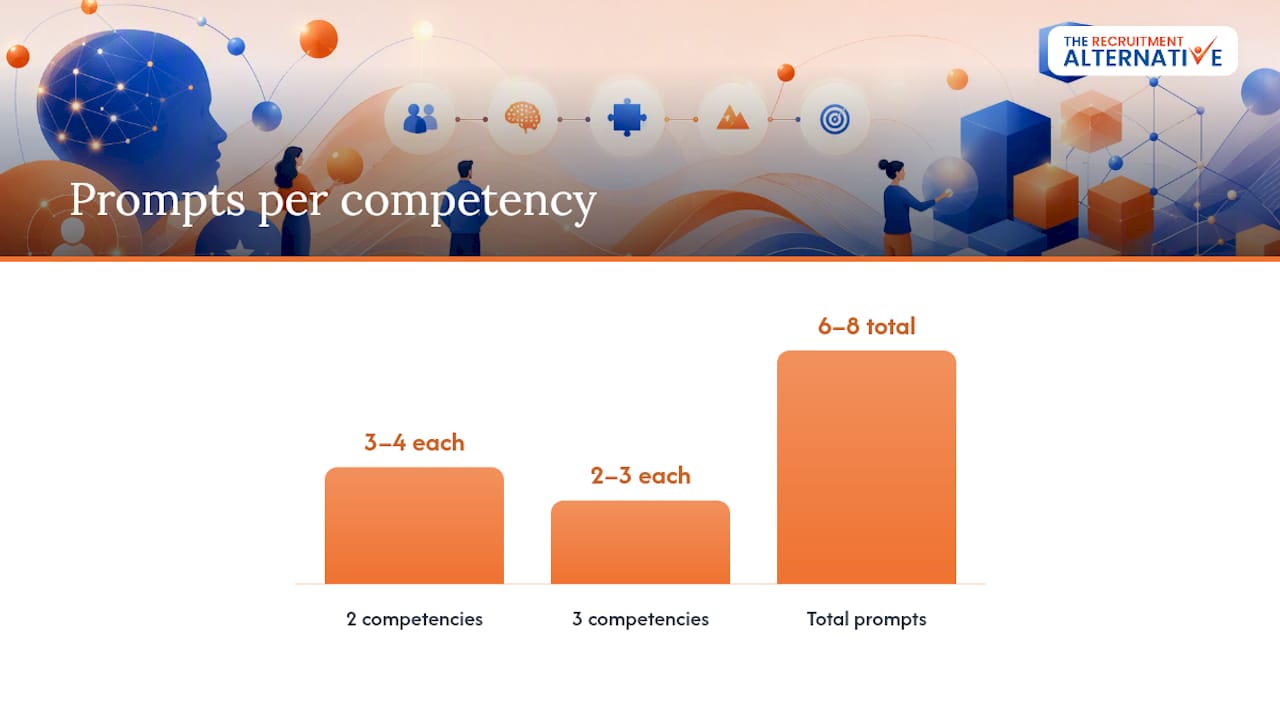
Pick 6 to 8 prompts across two or three competencies rather than trying to cover everything in one sitting. Each of these pairs a prompt with a short probe and what a strong (4 to 5) answer typically sounds like.
Problem solving
- “Tell me about a time you identified a process that wasn’t working.” Probe: “What data told you it wasn’t working?” Strong answer names a specific inefficiency and a measured improvement.
- “Describe a situation where you had to make a decision with incomplete information.” Probe: “What would you do differently now?”
Teamwork
- “Tell me about a conflict with a colleague and how you resolved it.” Probe: “What was the outcome for the team?”
- “Describe a time you had to rely on someone else to hit a deadline.” Probe: “How did you handle it when they fell short?”
Leadership
- “Tell me about a time you had to motivate a team through a difficult period.” Probe: “How did you know it worked?”
- “Describe how you’ve delegated a task that mattered to you.” Probe: “What did you check in on, and how often?”
Communication
- “Tell me about a time you had to explain something technical to a non-technical audience.” Probe: “How did you know they understood?”
Customer focus
- “Describe a situation where you had to manage a dissatisfied customer.” Probe: “What did you change afterwards?”
Candidates often coach themselves using the STAR or STARR method, structuring answers around situation, task, action, result, and reflection. Interviewers who understand that framework are better placed to probe for the “result” and “reflection” parts when a candidate skips them.
How do you run a structured interview without losing consistency?
Structure on paper falls apart if the room doesn’t follow it. A panel of two or three works well: one person asks and manages timing, another takes verbatim notes, and both score independently afterwards rather than discussing the answer as it happens.
Notes should capture what the candidate actually said before anyone assigns a rating. Scoring in real time invites the halo effect, where one strong early answer colours how you hear everything after it.
Video interviews need a few tweaks. Confirm the technology works before the interview starts, and build in a short buffer for lag or dropped calls. Our guide to running video interviews covers the practical setup. One small but powerful habit: tell candidates upfront that a short pause to think is completely fine. It noticeably reduces filler and rambling, and gives you a cleaner answer to score.
Common pitfalls that undermine structured interviews
Vague answers are the biggest tell. A candidate who answers “I’m a great communicator” without a specific example is usually avoiding the competency test rather than failing to understand the question. Push back with the pre-scripted probe rather than letting it slide.
Bias still creeps into structured formats. Similarity bias (favouring candidates who remind you of yourself) and the halo effect (one great answer colouring every later score) are the two most common. Structure narrows the damage, but doesn’t remove it entirely. If scores diverge sharply across a panel, rephrase the question for next time, re-check the anchor examples, and run a fresh calibration session before the next round.
A 5-step structured interview checklist
- Define 3 to 6 role outcomes and the competencies behind them.
- Draft behaviourally specific questions with pre-written probes.
- Build a scoring rubric with example behaviours at each level.
- Assign panel roles, set timeboxes, and pilot the questions on a small group.
- Score independently, then calibrate as a panel before making a decision.
For more interviewer-side tips, see our pointers on improving interview performance and our broader guidance on interviewing candidates.
What running structured interviews at scale actually teaches you
Most of the hiring mistakes I see aren’t about bad candidates. They’re about panels that ask different questions to different people and then wonder why the decision feels unfair to defend later. Structured interviewing solves that, but only when someone owns the rubric and enforces it, because a scoring sheet nobody actually uses is worse than useless.
The flat-fee model works well alongside structured interviewing because it rewards getting the process right the first time, not repeat placements. If you want to see how that fits into a broader hiring workflow, our guide to the recruitment consultation process walks through where structured interviews sit alongside sourcing and shortlisting.
— Josh Townsend
Want structured hiring without building the rubric yourself?
An alternative to a traditional agency for structured hiring is a fixed-fee service where the sourcing, screening, and structured assessment work is handled for you.
Permanent staff can be recruited across sales, admin, finance, engineering, healthcare, technology, trades, and executive roles, with job analysis and competency mapping built into every search. If you’d rather review a shortlist of properly assessed candidates than draft your own scoring rubric from scratch, our flat-fee recruitment service is worth a look. You can also check our simple flat-fee structure to see exactly what a placement costs before you commit. For hiring managers who want to sharpen their own panel first, tools like Muqabala offer candidates structured interview practice, which can also help you see which of your questions actually produce useful, specific answers. Get in touch to discuss your next role and explore how a fixed-fee, structured hiring process could simplify your recruitment.
Sources
- A guide to structured interviewing for better hiring practices — Google re:Work
- Structured interview questions guide — Workable
- Competency-based interviews — Prospects
- Behavioral and competency-based interviewing — University HR

