

If you have a clear role brief and the internal capacity to run background checks, award classification, and a paid trial properly, hire in-house using the checklist below. If you need the role filled quickly, lack HR bandwidth, or want licence and reference checks handled for you, engaging a fixed-fee recruiter like The Recruitment Alternative is the faster, lower-risk route. Either way, start by defining the exact plumber role you need before you write a single job ad.
TL;DR:
- Defining a precise role, including license class, physical requirements, and core tasks, is essential to avoid overpaying or underpaying for the right skills.
- Completing all compliance checks—such as registering as an employer, verifying right to work, and confirming award rates—prevents costly legal and financial mistakes.
- Building a candidate pipeline through referrals, trade schools, and networks reduces urgent hiring pressure and improves the quality of hires.
- Conducting a practical assessment or paid trial lasting two to four weeks helps verify on-site skills and punctuality beyond interview capabilities.
- Using a fixed-fee recruitment service can save time, lower risk, and ensure comprehensive candidate screening, license verification, and onboarding support.
Table of Contents
- Plumber hiring starts with defining the exact role
- What legal and compliance checks come before you advertise?
- Where do you find qualified plumbers who actually turn up?
- How do you screen and assess plumber candidates properly?
- Making the offer and drafting a compliant contract
- Onboarding and retention: keeping the plumber you just hired
- The hiring habit most employers get wrong
- A faster, fixed-fee route to hiring your plumber
- Where to check the rules before you finalise a hire
- Sources
- FAQ
Plumber hiring starts with defining the exact role
Most failed hires trace back to a vague brief. Before you touch a job board, decide whether you need an apprentice building experience, a fully licensed plumber who can work unsupervised, or a specialist (gas fitting, backflow prevention, drainage) for a niche contract stream. Each carries different pay expectations, supervision requirements, and lead time to productivity.
Work pattern matters just as much as the person’s skill level. A full-time permanent plumber suits steady residential or commercial workloads; casual or part-time arrangements fit seasonal spikes but complicate rostering and award entitlements.
Your job brief needs, at minimum:
- The specific licence class required (e.g. plumbing licence, gas fitting endorsement)
- Physical requirements (confined spaces, ladder work, manual handling limits)
- Core tasks and the proportion of solo vs supervised work
- A realistic pay range benchmarked against the applicable award
Get this wrong, and you will either overpay for skills you don’t need or underpay for a licence class the role demands.
What legal and compliance checks come before you advertise?
Skipping compliance setup is the single most expensive mistake employers make when hiring their first plumber. Sort these before you advertise:
- Register as an employer with the Australian Taxation Office and set up PAYG withholding and Single Touch Payroll reporting.
- Identify the correct award, typically the Plumbing and Fire Sprinklers Award, then confirm pay rates using Fair Work’s guidance on hiring employees and its Pay and Conditions Tool.
- Verify right to work, trade licences, and required insurances (public liability, workers’ compensation) before extending any offer.
- Distinguish employee from contractor status using the whole-of-relationship test Fair Work outlines, and get legal advice if the arrangement isn’t clear cut.
The Business also links to contract templates and award-finding tools that make step two faster.
Pro Tip: Misclassifying a plumber as a contractor when they function as an employee is one of the costliest errors in trades hiring. Back-pay, superannuation shortfalls, and fines can dwarf whatever you saved on payroll admin.
Where do you find qualified plumbers who actually turn up?
Job boards alone rarely produce your best hire. The channels that consistently deliver site-ready tradespeople, in rough order of yield:
- Employee referrals. Your current plumbers know who’s reliable and who isn’t; a referral bonus is usually cheaper than a month of job ads.
- TAFEs and trade schools. Building a relationship with a local training provider gives you early access to apprentices and near-qualified candidates, and tends to produce better long-term retention than random applicants, according to Explore The Trades.
- Apprenticeship networks and group training organisations, especially if you’re building a pipeline rather than filling one urgent vacancy.
- Targeted job board ads for licensed roles, plus trade-specific Facebook groups for word-of-mouth reach.
- LinkedIn, more useful for senior or specialist plumbers than entry-level trade roles.
If your local search comes up short, widen to a regional or national search and factor in relocation support. This is also the point where a recruiter earns their fee. If you’re advertising for three weeks with no suitable applicants, a specialist agency’s existing candidate network will almost always beat starting from zero. Our trades recruitment guide covers this pathway in more detail.
How do you screen and assess plumber candidates properly?
Interviews alone won’t tell you whether a plumber can actually do the job safely and on schedule. Build screening around four stages:
- Pre-screen documentation. Confirm licence numbers against the relevant state register, check right-to-work status, and call at least two references, not just the one the candidate nominates first.
- Structured interviews. Ask scenario questions (“Walk me through diagnosing a recurring leak in a multi-unit block”) alongside behavioural ones (“Tell me about a time you had to push back on an unsafe instruction from a client”). Involve your lead plumber or supervisor in the final round; they’ll spot technical red flags you might miss.
- Practical assessment. A half-day observed work sample, or better, a paid trial of two to four weeks, reveals punctuality, tool handling, and on-site behaviour that no interview surfaces. Trades employer guides consistently recommend this over relying on interviews alone.
- Background checks. Run these transparently. Tell candidates upfront what you’re checking (licence validity, police check if handling security-sensitive sites, driving record if a company vehicle is involved) and why.
Pro Tip: A paid trial isn’t a loophole to avoid making a real offer. Treat it as a genuine two to four week assessment with clear success criteria, paid at the award rate, and you’ll avoid both bad hires and unfair dismissal disputes.
Making the offer and drafting a compliant contract
Once you’ve settled on a candidate, move quickly. A slow offer process is how good plumbers end up accepting a competitor’s job first.
Your offer and contract need to cover:
- Base pay, allowances, and hours aligned to the correct award classification
- Probation length and what “success” looks like by the end of it
- Notice periods and any relocation assistance, including repayment terms if the person leaves early
- Start date, initial roster, and who they report to on day one
Use an award-aligned contract template rather than a generic one pulled offline, and get legal review on any restrictive clauses (non-compete, confidentiality) before you send it. The Business links to compliant templates that meet National Employment Standards obligations.
Onboarding and retention: keeping the plumber you just hired
The first week decides whether a new plumber sticks around. A basic induction checklist should cover safety briefings, tool and vehicle allocation, an introduction to their direct supervisor, and a manageable first assignment rather than the hardest job on the board.
Beyond week one, build in structured support:
- Apprentice supervision or ticket-upgrade pathways if the role involves skill progression
- Clear, published rosters so shift expectations don’t shift week to week
- Regular one-on-one check-ins in the first three months, not just a single formal review
Retention in the trades comes down to unglamorous basics: paying fairly against the award, recognising good work, and giving people a visible path to more responsibility or a licence upgrade.
Pro Tip: A five-minute check-in every Friday for the first month catches small frustrations before they become resignations. It costs you nothing and tells the new hire someone’s actually paying attention.
The hiring habit most employers get wrong
The biggest mistake in plumber hiring isn’t a bad interview question. It’s starting the search the day someone quits, with no brief ready, no pipeline warm, and no idea what “qualified” actually means for the specific job. Rushed hires skip the licence check, skip the second reference, and skip the trial period, then wonder why the plumber they hired in a panic didn’t work out three months later.
The fix is boring but effective: always be recruiting. Keep a shortlist of promising candidates from referrals and TAFE relationships even when you’re not actively hiring, so the next vacancy doesn’t start from zero.
— Josh Townsend
A faster, fixed-fee route to hiring your plumber
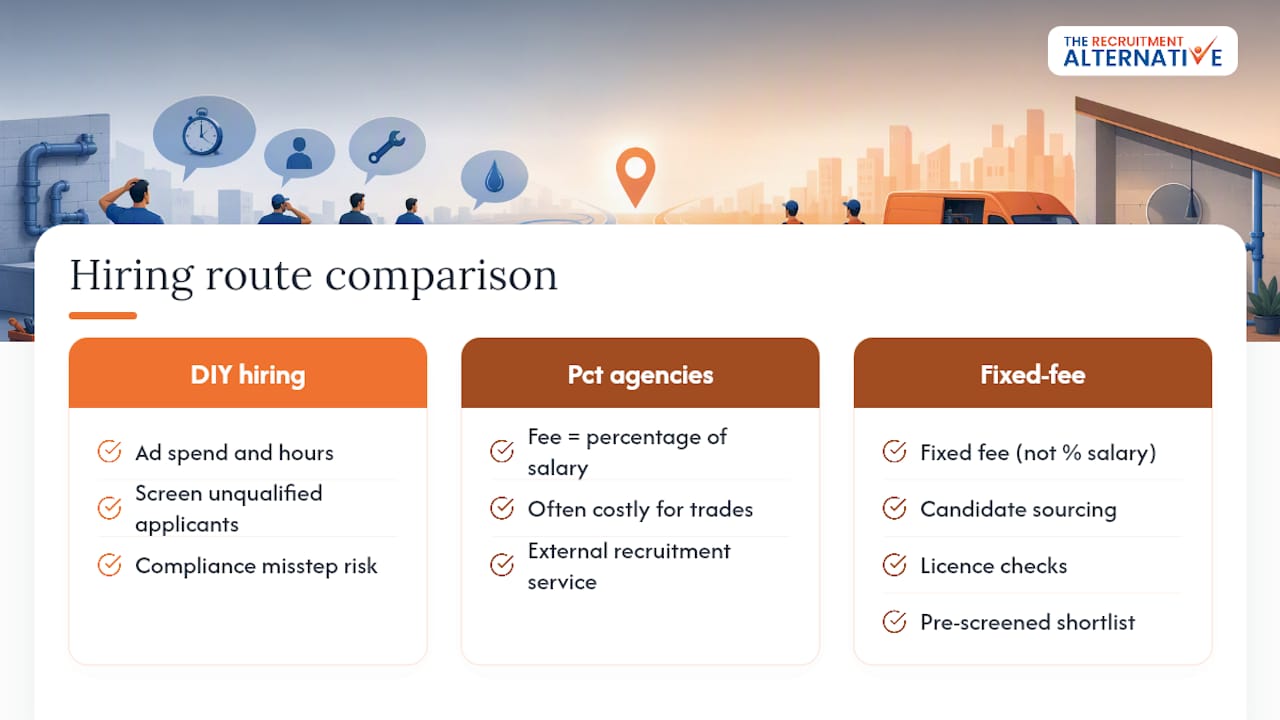
There’s a real cost to running the whole process above yourself: advertising spend, hours spent screening unqualified applicants, and the risk of a compliance misstep on award classification or contractor status. A fixed-fee recruitment service can be a good alternative to both DIY hiring and traditional percentage-based agencies, built for exactly this scenario.

Our service covers candidate sourcing, licence and reference verification, a shortlist of pre-screened plumbers, and replacement cover if the placement doesn’t work out in the first two to three months. It’s the better option when you need the role filled fast, don’t have in-house HR capacity to run every legal check yourself, or simply want the risk of a bad hire taken off your plate. Because the fee is fixed rather than a percentage of salary, the cost saving over a traditional agency can be substantial, particularly for trades roles where margins are already tight.
If you’d rather hand the search to a team that does this daily, see our flat-fee pricing structure and start a conversation about your flat-fee recruitment options today. For businesses hiring across trades more broadly, our trades recruitment guide outlines how the process works from brief to placement.
Where to check the rules before you finalise a hire
Before signing anyone, confirm the detail against primary sources: the ATO’s guide for first-time employers covers PAYG and Single Touch Payroll, Fair Work’s hiring employees page covers awards and contractor tests, and business.gov.au’s hiring guide links to templates and apprenticeship resources. If you’re hiring plumbers to service other trade businesses, a partner like Plumber SEO Services can help your new hire generate work once they’re on the tools.
Sources
- Australian Taxation Office — Before you hire your first worker
- Business
- Fair Work Ombudsman — Hiring employees
- Explore The Trades — How Do I Find and Hire Reliable Plumbers for My Business?
FAQ
How much does it cost to hire a plumber as a permanent employee?
Costs include the award-mandated wage, superannuation, workers’ compensation insurance, and recruitment expenses such as advertising or agency fees; a fixed-fee recruiter typically costs less than a traditional percentage-based agency charging a share of the plumber’s annual salary.
How long does the plumber hiring process usually take?
A DIY hire, from posting the job to a plumber’s start date, commonly takes several weeks when you include advertising, screening, a paid trial, and notice periods; engaging a specialist recruiter with an existing candidate pool can shorten this considerably.
What qualifications should I check before hiring a plumber?
Verify the specific state licence class required for the work (general plumbing, gas fitting, drainage), confirm it’s current, and check any additional endorsements needed for the tasks in your job brief.
Is a paid trial period legal when hiring a plumber?
Yes, provided the trial is paid at the correct award rate and structured as genuine employment or a legitimate work trial rather than unpaid “work experience”; check Fair Work’s guidance if you’re unsure how to structure it.
Should I hire a plumber directly or use a recruitment agency?
Hire directly if you have time, HR capability, and a strong local network; use a fixed-fee agency like The Recruitment Alternative when speed, licence verification, and reducing hiring risk matter more than managing the process entirely in-house.

